Like previous posts, this article accompanies a prototype app with the corresponding functionality. GitHub Repository: https://github.com/adamkent/local_democracy
In recent years, many aspects of daily life—banking, healthcare access, and communication—have moved online. However, democratic participation in local governance remains limited, both in accessibility and responsiveness. This article outlines the rationale for a digital platform that would enable residents to vote directly on relevant local council decisions, grounded in verified identity and address data provided by forthcoming UK digital ID infrastructure. This example features a citizen’s voting framework for local government/council matters, however a similar framework could be utilised for national referendums and general voting, with integrity grounded in the digital ID infrastructure, the UK GOV One Login system, and open-access data/results.
Background
UK local councils are responsible for decisions affecting planning, infrastructure, local services, and budget allocations. These decisions are typically made by elected councillors, with limited ongoing input from the broader public. Engagement levels are low: turnout for local elections is often below 35%, and public consultation processes reach only a small proportion of residents.
A secure digital voting platform could provide a mechanism for eligible residents to participate in selected local decisions in a verifiable and scalable way. The recent rollout of the GOV.UK One Login system and the GOV.UK Wallet enables identity verification tied to residential address. This infrastructure could be used to allow participation only by residents of a given council area, enforcing geographic relevance and preventing misuse.
Design
Digital systems intended for public governance must tread carefully between ease-of-access, trust, and legitimacy. This platform is not intended to replace representative democracy but to enhance local participation in areas where resident input can meaningfully shape outcomes. It must be:
- Geographically scoped: Votes must be relevant only to verified residents of a particular local authority.
- Accessible: Usable by residents across all digital literacy levels.
- Trustworthy: Identity must be verified, and results transparently handled.
- Scalable: Councils should be able to adopt and locally customise without rebuilding.
Platform Overview
The platform consists of two primary components:
- Council Administration Portal
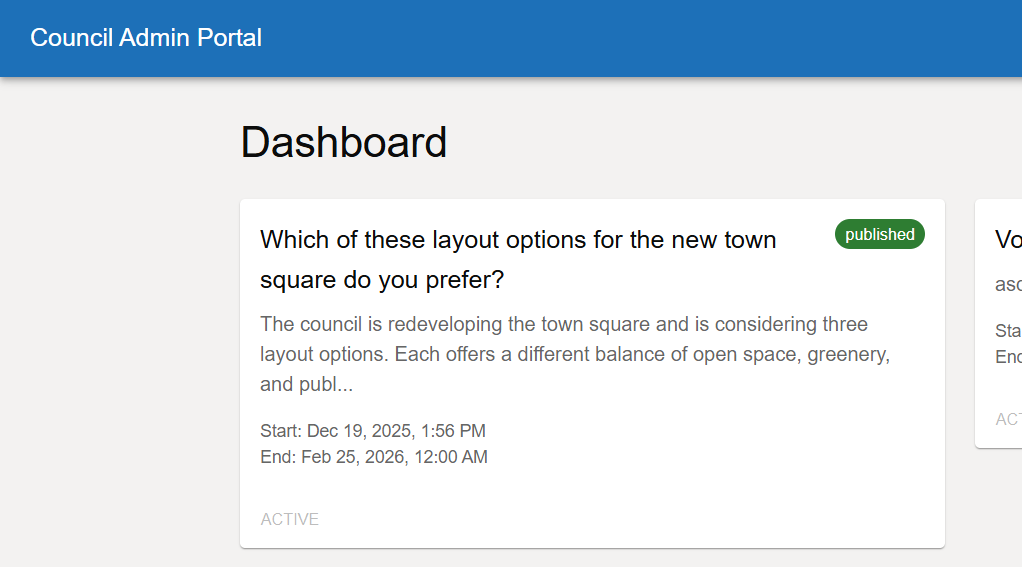
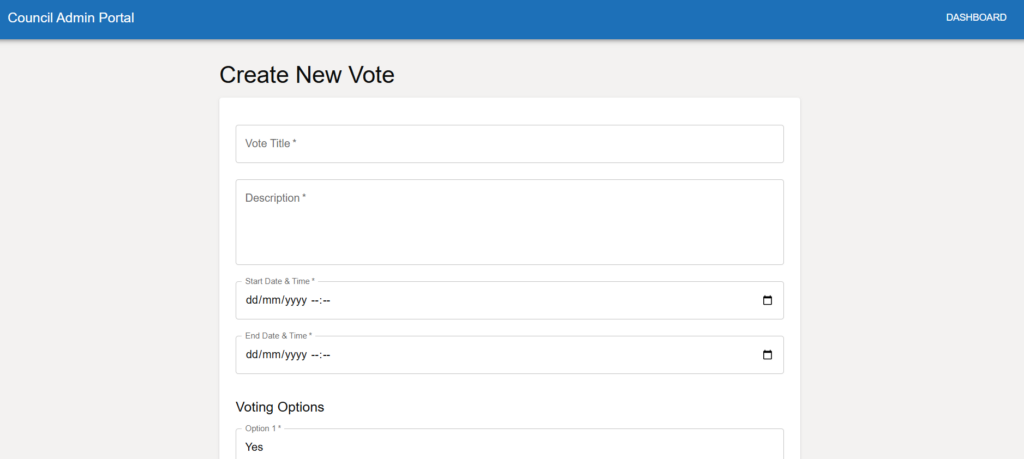
- Authenticated council staff can draft, publish, and manage vote cards.
- Each vote includes a title, description, scope (ward/postcode), options, open/close dates.
- Metadata allows threshold setting, preview visibility, and fallback mechanisms.
- Admins can view aggregate turnout and anonymous result breakdowns.
- Resident Voting Portal
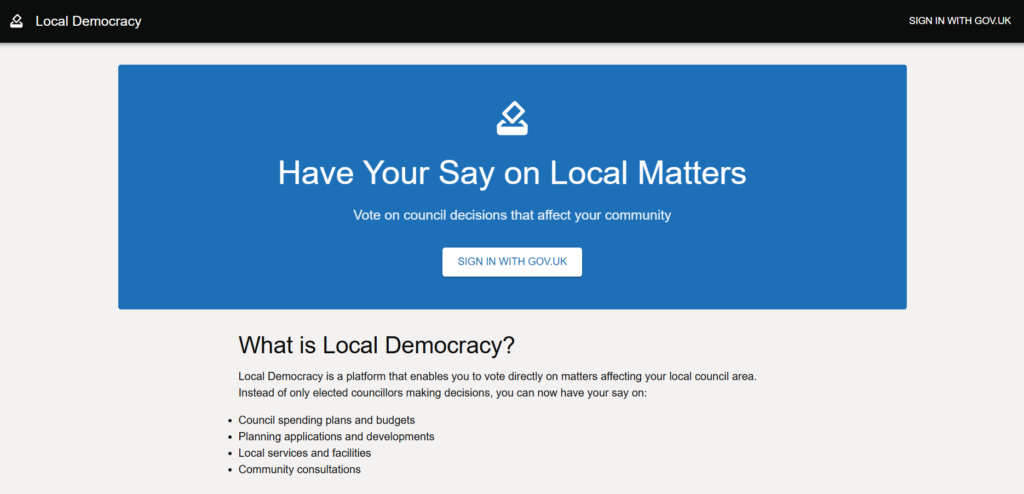
- Users log in (initially with local accounts; in future via One Login / GOV.UK Wallet).
- The system verifies their address, maps it to a local council, and scopes visibility accordingly.
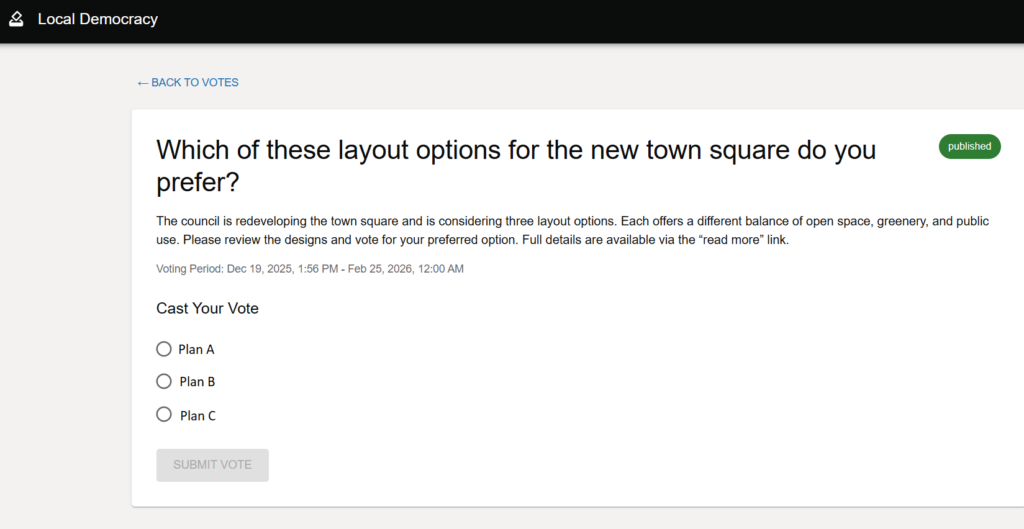
- Users view available vote cards, review context (with optional extended briefings), and submit votes.
- One vote per verified identity per vote event is enforced.
Jurisdiction Enforcement and Data Separation
Address-to-council mapping is achieved using authoritative datasets such as the Office for National Statistics Postcode Directory (ONSPD), which links postcodes to local authority identifiers. A strict one-to-one match is required to prevent users from seeing or voting on matters outside their area. This ensures council data isolation and builds confidence in vote integrity.
Example Use Cases
- Reallocating Community Space: Residents choose between options for a disused local plot (e.g. garden, car park, housing).
- Consultation on Budget Cuts: A transparent, structured vote on which non-mandatory services should retain funding.
- Local Planning Opinions: Polling residents in directly affected streets about preferred mitigation for building work.
Each vote is tied to observable impacts, and councils are encouraged to follow through with transparent reporting.
UX Design
To support high engagement and reduce uninformed or reactionary responses, the platform uses:
- Layered Context: A summary view followed by optional detailed briefs (PDFs, policy memos, videos).
- Clear Wording: Non-leading language, consistent across events.
- Preview Mode: Allows residents to review upcoming votes before opening.
These reduce the risk of the platform becoming symbolic theatre or a protest outlet.
Turnout Thresholds and Signal Weighting
Voting events include configurable turnout models:
- Turnout thresholds are relative to affected households or total eligible users.
- If turnout is below a defined threshold, votes are advisory. If exceeded, councils may choose to bind action.
This approach balances inclusivity with practicality, avoiding false mandates from low participation.
Identity, Security, and Trust
- Users are authenticated with strong identity verification systems (e.g. GOV.UK One Login, when available).
- Address data is used strictly for council mapping; not stored unnecessarily.
- Votes are encrypted and anonymised. No link exists between identity and vote content.
- The system protects against multiple submissions, session spoofing, or geographic crossover.
All access and vote events are logged in append-only audit trails.
Current Status
A working prototype demonstrates the core flows:
- Admin dashboard for creating scoped votes.
- Resident interface for identity-confirmed voting.
- Turnout-aware result logic.
The backend is built in Python (FastAPI), the frontend in TypeScript, with Dockerised database support for local dev. AWS infrastructure (RDS, ECS, Lambda) is prepared for future production deployment.
See code and screenshots:
- GitHub Repository: https://github.com/adamkent/local_democracy
Next Steps
Councils, civic technologists, and community advocates are invited to test, critique, and improve the model. This sort of digital local engagement is now technically feasible—the task ahead is governance alignment, public trust, and careful design.
Leave a Reply